Sony FX5: why open gate and internal RAW matter more than another spec bump
 By Ryan Robert Rice ·
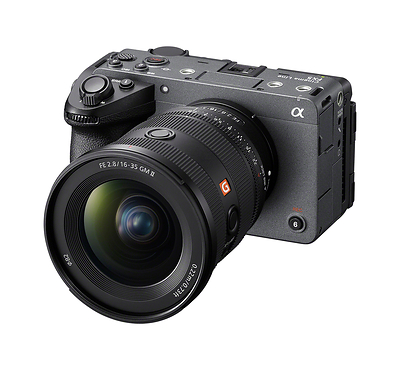
The Sony FX5 is interesting for a specific reason: it brings more flexibility to a compact production camera. Open-gate capture gives an editor more room to frame different deliverables, while internal RAW can remove an external recorder from some setups. For work that needs a horizontal video, a vertical cut and room for a careful grade, those changes can matter more than simply chasing a higher resolution number.
This is a researched buying guide based on Sony’s published information, checked November 18, 2026. I have not claimed hands-on testing or ownership of the FX5. My recommendations below are about how its features could fit a production, not a measured verdict on image quality or reliability.
As an Amazon Associate I earn from qualifying purchases.
Search Amazon for the Sony FX5 body — paid link. This is a model-specific search, not a verified in-stock listing. Confirm the seller, body or handle package, warranty and delivery date.
What Sony actually announced
Sony’s July announcement describes a full-frame, fully stacked Exmor RS CMOS sensor, BIONZ XR2 processing and internal X-OCN RAW. The published recording headline is up to 5K60, 4K120 and Full HD240. Sony also specifies three base ISO settings—800, 4000 and 12800—and claims more than 15 stops of dynamic range in S-Log3. Those are manufacturer specifications and claims, not results from my own exposure tests.
The launch suggested prices were $4,899.99 for the body and $5,499.99 with the XLR handle. Treat those as dated reference points. The cost of a usable kit also includes lenses, suitable recording media, backup storage and whatever audio and support equipment your jobs require.
Open gate: one recording, more framing options
Open gate uses a taller 3:2 sensor area instead of committing immediately to a wide video frame. Imagine filming an interview that needs both a landscape YouTube edit and a vertical social clip. That extra image area can give you more options when placing the crop, especially around a subject’s hands or head.
It does not make every composition work in every shape. Two people spaced across a wide frame can still be difficult to fit into a vertical crop. I would plan both deliverables before shooting, protect the important action in both compositions, and treat the extra pixels as flexibility rather than permission to ignore framing.
There is a significant format restriction: Sony says open-gate recording is available only in X-OCN. Its Dual Gain mode supports up to 30 fps in full-frame 5K 3:2 and up to 60 fps in 5K 16:9 or 17:9. Do not assume that every headline feature can be enabled together at the maximum advertised frame rate.
Internal RAW: less hardware, more post-production planning
Recording RAW inside the camera can simplify a compact rig. It can also move more responsibility into post-production. Before choosing the FX5 for a paid job, test an actual sample through your editor, color pipeline, proxy creation and final export. A format being supported somewhere does not establish that your current software version and computer will play it smoothly.
Sony’s X-OCN documentation lists LT, C1 and C2 recording options. The FX5 section specifies CFexpress Type A VPG400 media for guaranteed X-OCN operation. Although the camera has slots that also accept SD cards, that does not make an SD card a substitute for every recording mode. Buy media for the format you intend to use.
My practical approach would be to work backward from delivery: choose the format the project needs, estimate storage from a representative recording, and test a backup before the shoot. A more demanding original is worthwhile when the edit benefits from it. It is less attractive when it slows a simple same-day delivery without solving a visible problem.
Handheld operation and monitoring
Sony lists five-axis sensor-shift stabilization and a 3.5-inch touchscreen on an adjustable arm. The body also has a full-size HDMI connection, two USB-C ports and wired networking. Those details are useful when thinking about a camera as part of a working setup, rather than as an isolated sensor.
For a small crew, screen positioning and accessible connections affect how quickly you can move between a tripod, a handheld shot and a more built-out rig. Stabilization still does not replace every use of a tripod or gimbal. Test the exact lens, movement and stabilization setting; electronic stabilization modes can change the angle of view, and mode restrictions matter.
Audio: price the handle you actually need
Sony announced a separate XLR handle capable of in-camera recording up to 96 kHz and 32-bit float. A body-only price should not be compared with a competing kit that already includes the audio hardware you require. Check the package rather than relying on a photo showing accessories.
For an interview, I would plan the microphones, headphone monitoring and recording checks before focusing on the bit-depth headline. A more flexible audio file cannot repair a microphone brushing against clothing or placed too far from the speaker. The value is in the complete recording setup and the person checking it.
Sony FX5 versus FX3A
The FX3A remains a relevant comparison for someone whose delivery is predominantly 4K. Sony lists internal 10-bit 4:2:2 XAVC and UHD 4K up to 120p. If your existing process already produces good results with that kind of footage, changing cameras needs a clearer reason than the FX5 being newer.
I would shortlist the FX5 when open gate or internal X-OCN solves a recurring production problem. I would compare the FX3A when those features are optional and the total kit cost matters more. That is a workflow distinction, not a claim that the cameras have identical autofocus, dynamic range or color performance.
Compare Sony FX3A listings on Amazon — paid link.
Sony FX5 versus FX30
The FX30 uses a Super 35 sensor and supports 4K recording up to 120p; Sony describes 6K oversampling for its 4K modes up to 60p. Its different sensor format affects lens selection and framing. Compare the complete lens-and-camera kit needed for your shots, not only the body names.
For someone building a first production setup, I would compare an FX30 kit with money left for lighting, audio and support against spending most of the budget on an FX5 body. The FX5 becomes easier to justify when the work specifically calls for its recording options. Buying those options before you need them is a preference, not a guaranteed business return.
Compare Sony FX30 listings on Amazon — paid link.
Do not buy future firmware as if it is already installed
Sony lists 5K 3:2 X-OCN at 120 fps and 4K240 as planned firmware capabilities for August 2027 or later. They are not treated as currently available features in this guide. Base a purchase on the shipping functionality that meets your needs today, then check Sony’s support information when an update actually arrives.
My take
The FX5 deserves attention from filmmakers who repeatedly need flexible framing and a RAW workflow in a compact body. The strongest buying argument is that those capabilities remove a real limitation from your current jobs. Before committing, I would rent or test it with the intended lenses and run the footage through the actual delivery process. If the benefit survives that test—and the full kit fits the budget—the upgrade has a much clearer purpose.